He wasn’t begging for himself. That’s what broke me.
The Night I Almost Walked Past Him
Some nights feel heavier than others.
That Tuesday evening was one of them.
Earlier that morning, my divorce had become official. Years of memories, arguments, promises, and disappointments had finally been reduced to a stack of signed papers.
By 8 p.m., I wasn’t looking for company. I wasn’t looking for answers.
I was simply driving to Walmart to buy a bottle of wine and spend the evening feeling sorry for myself.
Then I saw him.
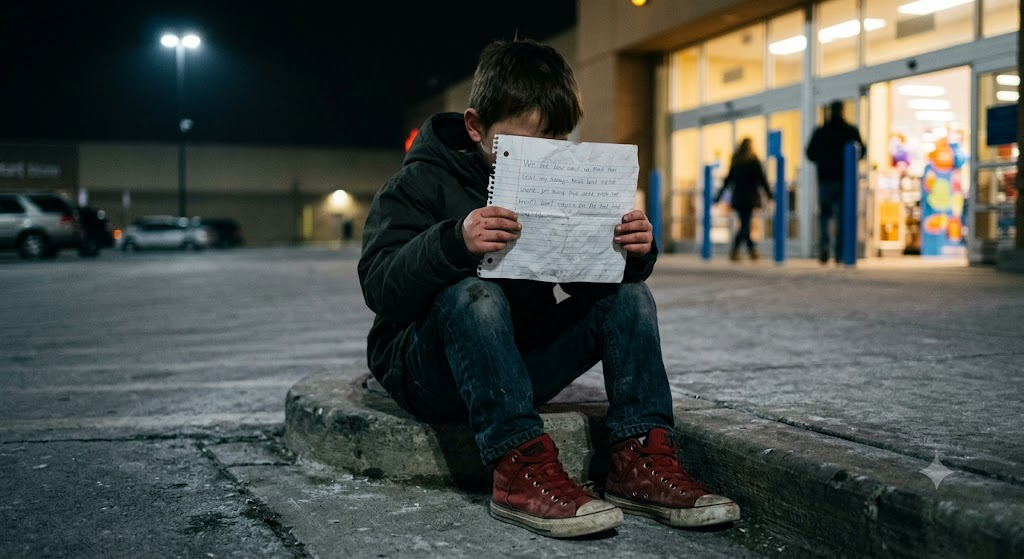
A small boy sitting alone near the entrance.
Maybe nine years old.
A dark hoodie. Worn sneakers. A backpack resting beside him.
He wasn’t asking people for money.
He wasn’t holding out a cup.
He was holding a piece of paper with both hands.
I almost walked past him.
In fact, I probably would have if there hadn’t been something unusual about the way he sat there.
Completely still.
Not calling out.
Not making eye contact.
Not trying to convince anyone to stop.
It looked as though he had already accepted that most people wouldn’t.
Something about that made me slow down.
I walked closer and looked at the paper.
The message wasn’t what I expected.
It didn’t say he was hungry.
It didn’t say he needed money.
Instead, it read:
“DOES ANYONE HAVE BLOOD TYPE O+? MY MOM NEEDS HELP. I DON’T KNOW WHAT ELSE TO DO.”
For a moment, everything around me seemed to disappear.
The cars.
The lights.
The people walking in and out of the store.
All I could see was this child sitting alone in a parking lot, carrying a burden no child should ever have to carry.
I asked him gently,
“How long have you been sitting here?”
He looked up at me.
His eyes were calm in the way children sometimes become calm after they’ve already cried all their tears.
“Since five,” he said.
Three hours.
Three hours alone.
Three hours hoping that someone—anyone—might stop.
I sat down beside him on the curb.
The bottle of wine no longer mattered.
My phone stayed in my pocket.
I simply asked,
“Tell me about your mom.”
And what he told me next is something I have never forgotten.
A Child’s Plan to Save His Mother
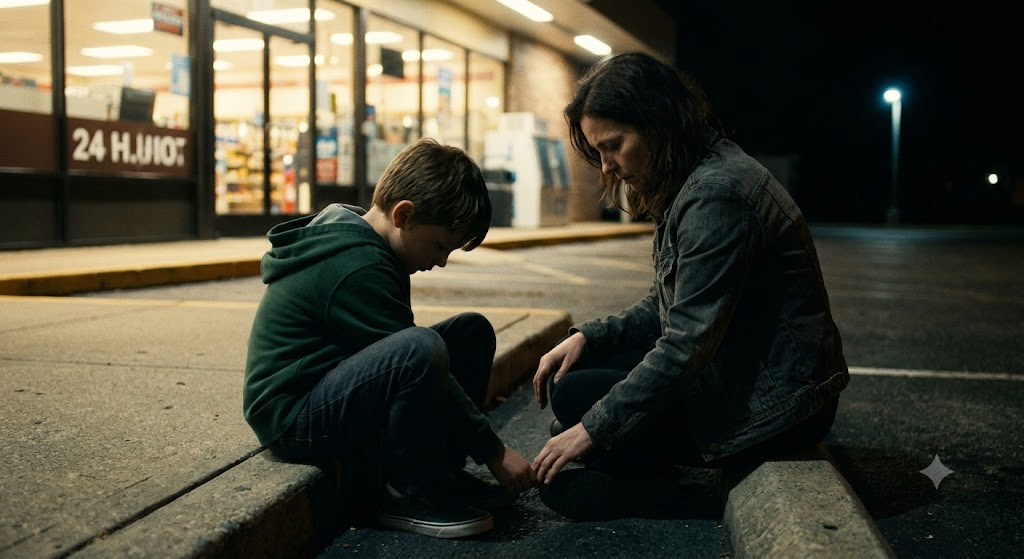
His name was Jake.
His mother, Diane, had been sick for weeks.
What began as stomach pain gradually became worse until she collapsed in their kitchen.
Jake was the one who called 911.
Jake was the one who unlocked the door for the paramedics.
Jake was the one who watched them take his mother away.
At the hospital, doctors discovered severe internal bleeding.
She needed surgery.
But there was a problem.
Her blood type was rare, and supplies were critically low.
The hospital needed matching donors.
Jake’s father had left years ago.
There were no nearby relatives.
No grandparents.
No aunts or uncles he knew how to reach.
So the boy did the only thing he could think of.
He made a sign.
He took a bus to the biggest store he knew.
And he waited.
“I know it’s weird,” he told me quietly.
“But I didn’t know what else to do.”
I asked whether he had eaten.
He shook his head.
I went inside Walmart.
Not for wine.
This time, I came back with a sandwich and a sports drink.
While he ate, I called the hospital number written on the back of his sign.
Everything he had told me was true.
The hospital confirmed it.
Diane was there.
The situation was serious.
Looking at that boy eating his sandwich under the store lights, I made a decision.
“Jake,” I said.
“I’m going to take you to see your mom.”
For a moment, he simply stared at me.
Then he picked up his backpack.
“Okay,” he said softly.
“Thank you.”
Room 412
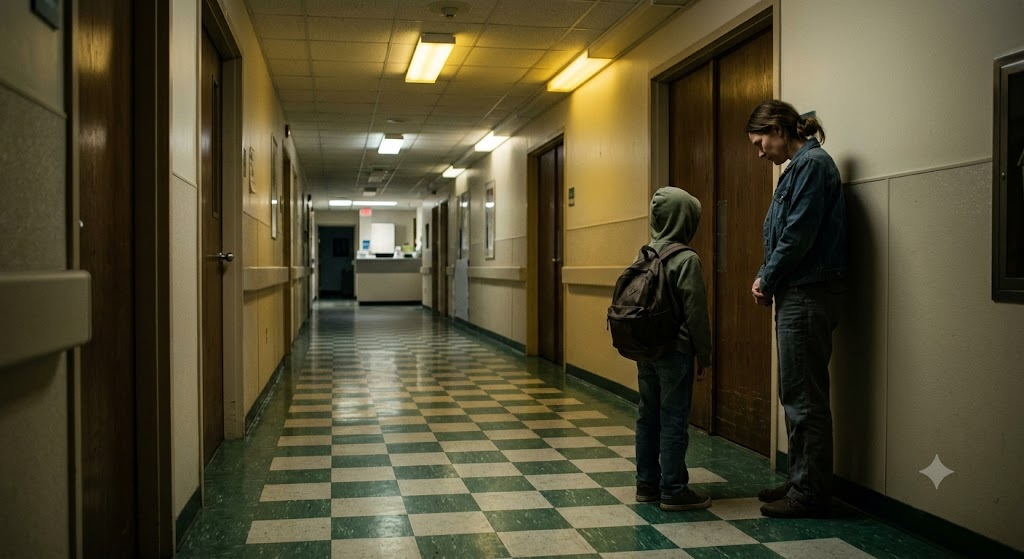
The nurse recognized Jake immediately.
She seemed relieved to see him.
Jake’s first question was simple.
“Can she have surgery now?”
The nurse hesitated.
Then she explained.
The hospital had located a matching donor through its network.
The surgery could move forward.
But another problem had appeared.
Diane was unconscious.
There was no documented family member available to provide consent.
No spouse.
No guardian.
No adult relative.
And Jake was only nine years old.
I asked what would happen.
The nurse explained that emergency legal approval could be obtained through the courts.
But it would take time.
Hours.
Time Diane might not have.
Jake stood quietly beside me listening to every word.
He didn’t cry.
He didn’t panic.
He simply looked up at me.
I’ll never forget that look.
There was no demand in it.
No expectation.
Just hope.
I had known this child for less than two hours.
I didn’t know his family.
I didn’t know his history.
But somehow, in that moment, none of that seemed important.
I looked at the nurse and asked,
“What do I need to sign?”
She blinked.
“Are you family?”
I glanced at Jake.
Then I answered:
“No.”
I paused.
“But I’m the one who showed up.”
And she handed me the clipboard.
The Knock on My Door
The surgery lasted four hours.
Jake and I waited together.
He even worked on a math worksheet from his backpack.
As if this was somehow a normal evening.
Shortly after one in the morning, the surgeon emerged.
The words we had been waiting for finally arrived.
“She’s out. It went well.”
Jake closed his notebook.
He didn’t celebrate.
He didn’t shout.
He simply lowered his head into his hands for a few seconds.
When he looked up again, he asked one question.
“Can I see her?”
They let him in.
I stayed outside.
Later, hospital staff arranged for him to stay safely overnight.
I left my phone number with the front desk and finally drove home.
I had left for Walmart expecting to buy wine.
Instead, I returned home after 2 a.m. having helped save a stranger’s life.
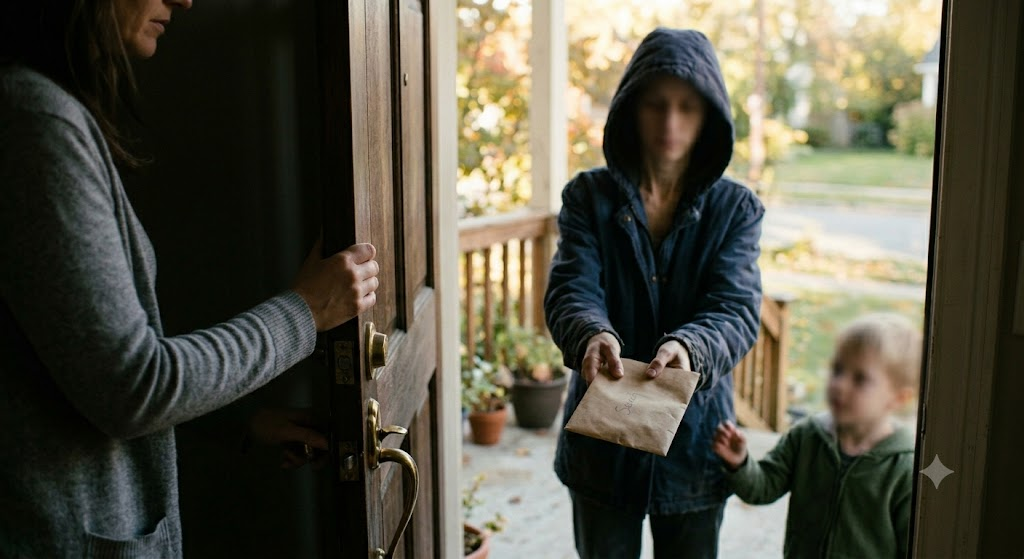
Two weeks later, someone knocked on my front door.
Standing there was Diane.
Pale.
Still recovering.
Jake stood beside her.
Backpack on his shoulders, just like the night we met.
For a long moment, nobody spoke.
Then Diane said,
“I don’t know how to thank you.”
She handed me a small envelope.
Inside was a folded sheet of paper.
Not money.
Not a gift card.
Just a handwritten note.
Jake’s handwriting.
Uneven letters.
Slightly smudged.
It read:
“You were the answer to my sign.”
And standing there in my doorway, I cried.
Not because I was sad.
But because I realized how close I had come to walking past him.
That night, I thought I was the broken one.
I thought I was the person who needed saving.
Instead, a nine-year-old boy reminded me that sometimes the people we help end up helping us even more.
The world can feel cold.
People can disappoint us.
Life can knock us down when we least expect it.
But every now and then, a stranger appears and reminds us that kindness still exists.
Sometimes all it takes is one person willing to stop.
And one child brave enough not to give up.
Final Thought
Whenever I start believing the world has become too hard, too divided, or too indifferent, I think about Jake.
A little boy sitting on a curb for three hours.
Holding a sign.
Refusing to lose hope.
And I remember this:
Be the person who stops.
